
Many plant enthusiasts often will utilize a moss pole to help train their plants to grow upwards. Using a moss pole is ideal if you also want your plants to produce total leaf growth. Moss poles help your plants flourish by supporting their development, training their growth habits, and providing extra micronutrients to those vines with adventitious roots. Furthermore, contact between aerial roots and the moss pole can induce the development of bigger, more mature leaves in some plants.
A moss pole is not only a great way to help your plant grow more successfully but allows it to do so naturally as well. Let’s dig into how to train your plant to trail around a moss pole for more significant leaf growth.
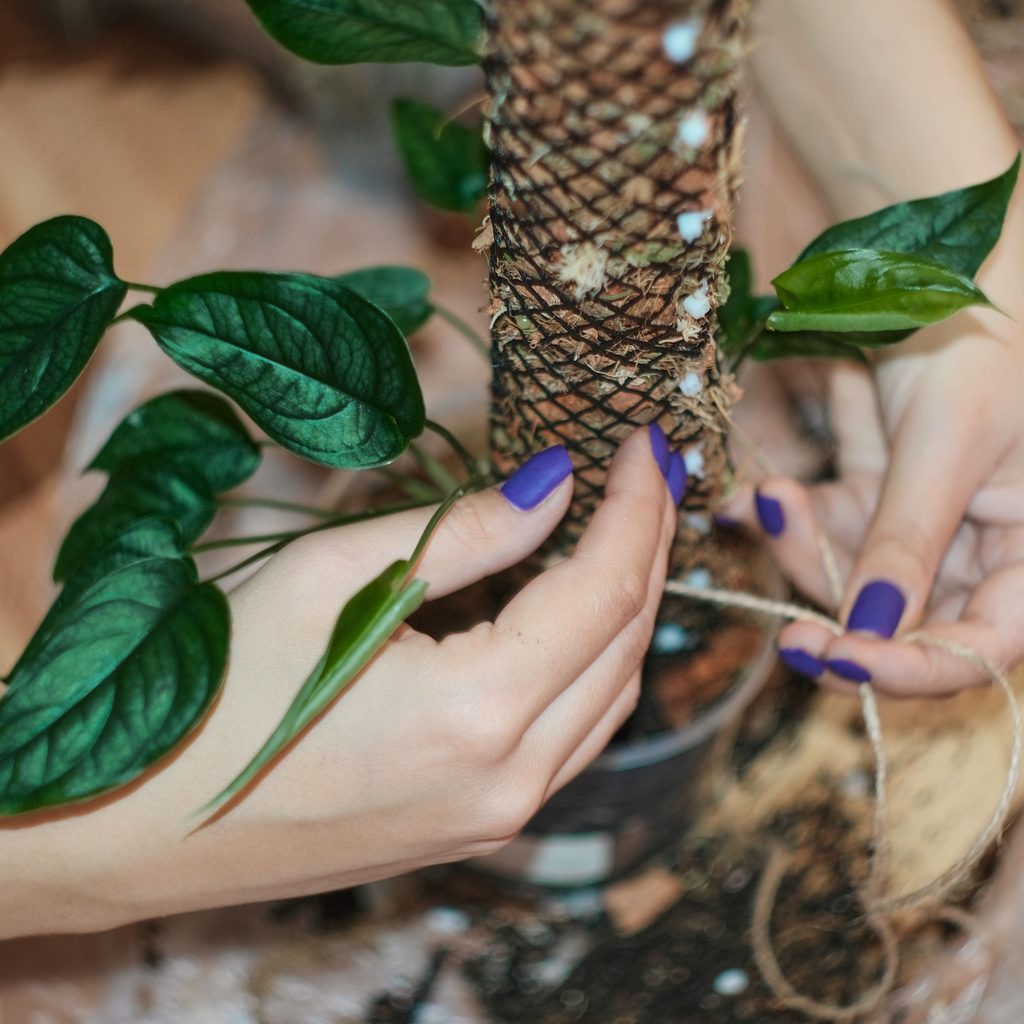
What is a moss pole?
A moss pole is a solid columnar length of material that’s been covered with coco coir or sphagnum moss. The rod is inserted into the soil of potted plants to provide stability for tropical and climbing plants that stand upright. Moss poles are used to support plants and improve their aesthetics by encouraging them to grow vertically rather than horizontally or in a bent manner. Often, you’ll want to source moss poles taller than your existing plant to ensure vertical growth. These poles are designed to resemble the natural environment in which tropical plants usually thrive in order to create a favorable environment for them to flourish in. As a result, the plants tend to grow healthier while producing more lush and green leafy vegetation.
Benefits of using a moss pole
There are numerous benefits to using a moss pole to train your plant to grow upwards. Below are some of the added benefits that a moss pole can provide to your plants.
- Provides support for plants to grow vertically. Roots of vining species can easily attach to the fibrous material of the moss pole while securing the plant and encouraging its further growth.
- Supplies moisture to the plant. Moss poles are commonly made with water-retentive materials, so watering or spot spraying the rod will allow it to store additional water for the plants’ aerial roots to access as well.
- Helps plants progress to maturity. Taller plants will often grow closer to the sunlight canopy and adapt to capitalize on this scenario. This can potentially lead to larger plants and more remarkable leaf growth, among other benefits.
- Proves space-efficient solution. Even when low on space for new plants, climbing plants can be trained to occupy vertical space instead of horizontal space.
- Makes unattractive plants look attractive. On occasion, some vining species end up looking like all stem and no foliage. When you integrate the plant’s stem with the central moss pole, it visually removes the stem and highlights the foliage more.
- Increase the plant’s shape to grow density of the foliage. By wrapping the plant around a moss pole, you’ll be able to bring leaves closer together and shape the plants’ foliage.
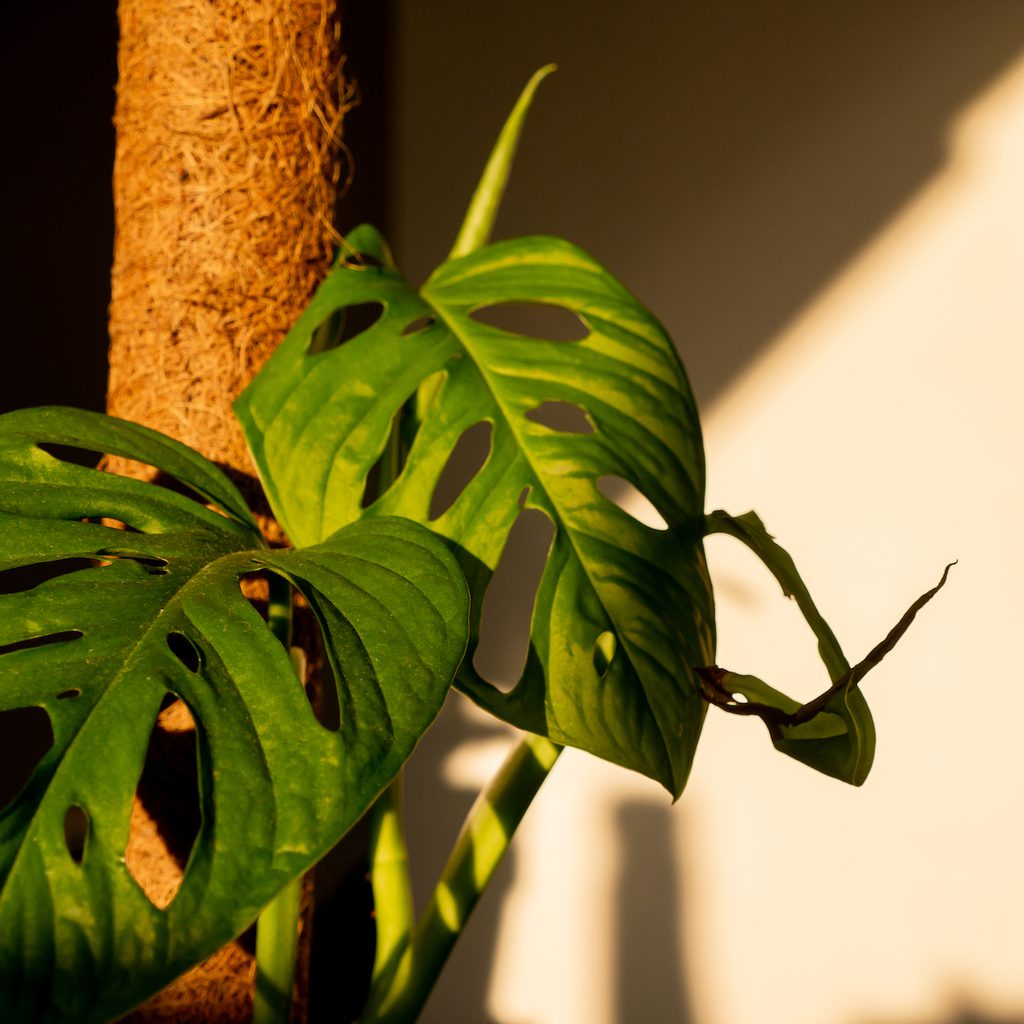
Attachment to the moss pole is critical
To train your plants to climb a moss pole and produce more greenery and leaves, you must begin by adequately attaching it to the pole. This step is critical to train your plants because they must first link to the stake to promote upward growth and foliage. Plants are triggered to connect directly with the contact of the pole surface, and binding them closely will enable this to occur. There are several ways you can attach your plants to the moss pole.
- Pin them using metal staples commonly in a U shape that allows you to press into the pole, capturing the stem in the middle.
- Wrap them with twine or wire by tying a loop around the outside of the stem and pole together and then tighten it to bind them together.
- Velcro straps or cable ties promote the same attachment as twine and are more secure for larger plants and stems.
- Some plants need minimal intervention in attaching to the moss pole, so utilize the plant itself by wrapping the vine gently around the pole, making sure the aerial roots have something to grip.
Training your plant to climb after attachment
Once your plant has successfully attached to the moss pole, you’ll need to continue to guide the plant vertically up the moss pole as it continues to grow. The more the plant grows up the stake, continue securing your plant further around the pole with your chosen attachment until it’s reached the top of the pole. Help promote more rooting and binding by misting the plant regularly and providing as much humidity as possible to the plant and stake. This will encourage more vertical climb and attachment for the plant.
As you continue to water and prune your plant, regularly check for new growth. Any new vine sections that aren’t growing tightly to the pole will need to be pruned or bound to the plant. Once the lower areas of your plant are tightly intertwined with the moss and the aerial roots and have embedded themselves into the moss, remove the lower ties and allow the plant to rely entirely on the moss pole for its support. This keeps your plant growing continually upward with the helpful support of its mossy structure.