
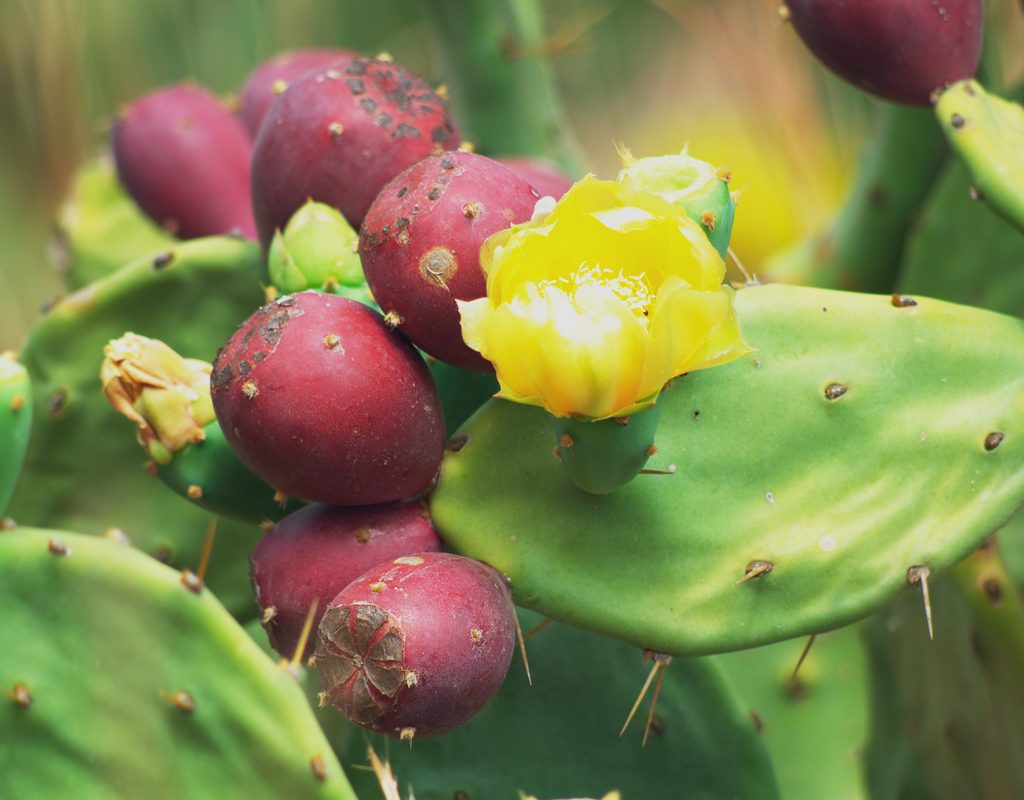
The Opuntia stricta (commonly known as the coastal prickly pear, the common pest pear, and the erect prickly pear) grows to just under seven feet tall at its mature height. They feature a similar shape to other prickly pear varieties and grow in segments; however, the Opuntia stricta grows tall and stiff, with the base segments sometimes thickening to a trunk-like structure. In the spring and summer, if you’re lucky, your coastal prickly pear will sport yellow and orange flowers, growing purplish-red prickly pear fruits.

Common varieties of Opuntia cacti
There are roughly 150 species of Opuntia cacti, and some are more popular for home gardeners than others. Most of these species can be grown outdoors in USDA hardiness zones 7 through 10 (with the coastal prickly pear being grown in zones 9a through 11b); however, many people choose to grow these cacti indoors as potted plants. The Opuntia stricta is part of a common group of spineless prickly pears, alongside the ellisiana and the robusta.
Other popular varieties, like the violacea and the basilaris, are what’s known commonly as “purple prickly pears.” These varieties are a purple-blue color, instead of the classic green color. The Opuntia violacea is unique in that when exposed to drought or other stressors, their purple hue will deepen in color.
What’s the scientific name of Opuntia?
Opuntia is part of the scientific name for the Opuntia stricta! It’s commonly known as the coastal prickly pear, among other names. Opuntia is the genus for this cactus, belonging to the Cactaceae family and Opuntioideae subfamily.
Are Opuntia and prickly pear the same?
Yes! The Opuntia genus is home to a wide variety of prickly pear cacti, though each one is different. For example, the Opuntia stricta is a stiff, shrug-like prickly pear cactus that can reach up to seven feet tall while the Opuntia ficus-indica can easily top 15 feet in height under the right conditions. Each variety has unique characteristics that identify them, but they’re all part of the same family, subfamily, and genus.
How to care for the Opuntia stricta
The good news is: If you have other Opuntia species, their care is relatively similar throughout the genus — so you already have a starting point! Outside of USDA zones 9a through 11b, the Opuntia stricta should be grown indoors and exclusively in pots. If your summers get warm enough and you have an outdoor space with bright light, you can always transition them outside for the warm season.
To properly repot your coastal prickly pear cactus, make sure the soil is dry first. This will keep the roots from getting damaged when you go to remove the old potting soil before transitioning your cactus to a new pot. Once the potting mix has been cleaned off, place your prickly pear in the new pot and fill with fresh soil.
As far as environmental conditions go, you want to make sure you’re growing your Opuntia stricta in an area that’s warm and relatively humid. Because they’re native to subtropical and tropical coastal regions in the Americas and the Caribbean, you should try your best to mimic that native environment as closely as possible. Keep these cacti away from drafty windows during cold spells, and if needed, place on a pebble tray filled with water to increase humidity when the space is dry.
Light needs: At least eight hours of full sun per day
Water needs: Drought tolerant; water using the soak and dry method roughly every two to four weeks
Soil needs: Well-draining soil
Propagating your coastal prickly pear
The coastal prickly pear cactus can be propagated via cuttings or seeds. When growing from seed, it can take a few years to grow a sturdy plant; however, if you start with a cutting, you already have a decent-sized plant to work with.
To propagate the Opuntia stricta from cuttings, gently remove a pad from the parent cactus (that’s ideally at least six months old) where it connects to another. Let the cut end heal over for about a week, then plant the cut end of the pad into the fresh cactus potting mix. Given the nature of the plant, you’ll likely need to provide some support (stakes on either side work wonderfully!) for the pad until it establishes new roots.
A common problem to keep in mind
The problem that plagues many cacti is overwatering. It’s very easy to try watering it like a spider plant or a pothos, but cacti (including the Opuntia stricta and other Opuntia varieties) prefer to be watered using the soak and dry method: Water the soil thoroughly until water starts draining out the bottom, then let the soil dry completely before watering again.
This is why it’s essential to pot your coastal prickly pear in a pot with good drainage. Proper watering and an ideal pot will help prevent the soil from getting soggy, which will hopefully keep the roots from sitting in water and rotting. If you notice the bottom parts of your plant are looking a little water-logged and mushy, chances are you’ve been watering a bit too much.
With the right care, an Opuntia stricta can be around for a long time! You can propagate their pads as gifts for friends and family, and even collect a wide variety of prickly pear cacti to grow in your home.


